Adina Afshan
When driving along Route 1 from Trenton to Princeton, there is a rapid and almost disorienting change in landscape. From wire-fenced lots and brownfields to manicured lands and research parks, it feels less like a stretch of highway and more like a border crossing. The spread between the two cities reveals that there is not just a difference in geography, but a deeply rooted socioecological divide shaped by race, class, and land use. This essay looks at the Trenton-Princeton Corridor through the lens of representation and inequality in America. It shows how cultural erasure, environmental neglect, and zoning practices create significant disparities in this area. The means of our lens, however, stems from the humble mushroom.
Kingdom Fungi, a group of eukaryotic organisms including yeasts, molds, and mushrooms, plays a crucial role in many ecosystems. They act as decomposers, breaking down plant and animal debris and cycling nutrients. They also act as soil restorers. This process includes the release of gases like carbon, oxygen, nitrogen, and phosphorus back into the soil and atmosphere, increasing availability for other organisms. By focusing on the roles fungi play (decomposers, connectors, and soil restorers), they can help us imagine ways to restore and regenerate the toxic and degraded landscape. They challenge the idea of constant advancement and serve as both a metaphor and a model for a future based on care, recollection, and ecological recovery.
Cultural Fragmentation and Diaspora in the Border Zone
Once a thriving industrial hub, Trenton is now home to vibrant Black and Latinx communities shaped by systemic neglect and disinvestment. Empty factories, neglected infrastructure, and community resilience coexist in its urban fabric. Even in this context of abandonment, rich cultural life persists through churches, street markets, community gardens, and grassroots organizations.
In contrast, Princeton has experienced significant demographic shifts, mostly a growing Asian population. Despite their presence, Asian (including South, Central, and Eastern Asian) communities remain underrepresented in the physical and cultural landscapes. Temples, grocery stores, and gathering places exist in fragments that are typically pushed to the outskirts of the town or converted office parks. Public acknowledgement of these communities within the design and layout of public space remains minimal. The built environment of Princeton does not reflect the diversity of those who inhabit it.
Route 1 and the Northeast rail corridor act as physical transit lines and symbolic dividers between the landscapes of Trenton and Princeton. Cultural nodes, such as temples, bodegas, and informal markets, are scattered across the corridor like islands, surrounded by zones of cultural erasure and absence. These fragmented presences reflect what Anna Tsing, a Chinese American anthropologist, describes as "survival in fragmented landscapes," where communities persist through informal, adaptive networks that challenge dominant spatial narratives. Tsing notes, "Precarity is the condition of being vulnerable to others. Unpredictable encounters transform us; we are not in control, even of ourselves."
As landscape architect and theorist James Corner suggests, mapping these layered systems allows us to see the border zone, not just as a line but as an ecology of overlaps and absences. "To map is to construct meaning within a complex and shifting world," Corner argues, emphasizing mapping as an act of speculation, critique, and invention. Urban planner Kevin Lynch's concept of cognitive mapping also helps us reveal how communities perceive and navigate uneven terrain; how memory and identity fill in the blanks of physical space. This type of mapping crafts personal and communal significance in areas where official recognition is lacking.
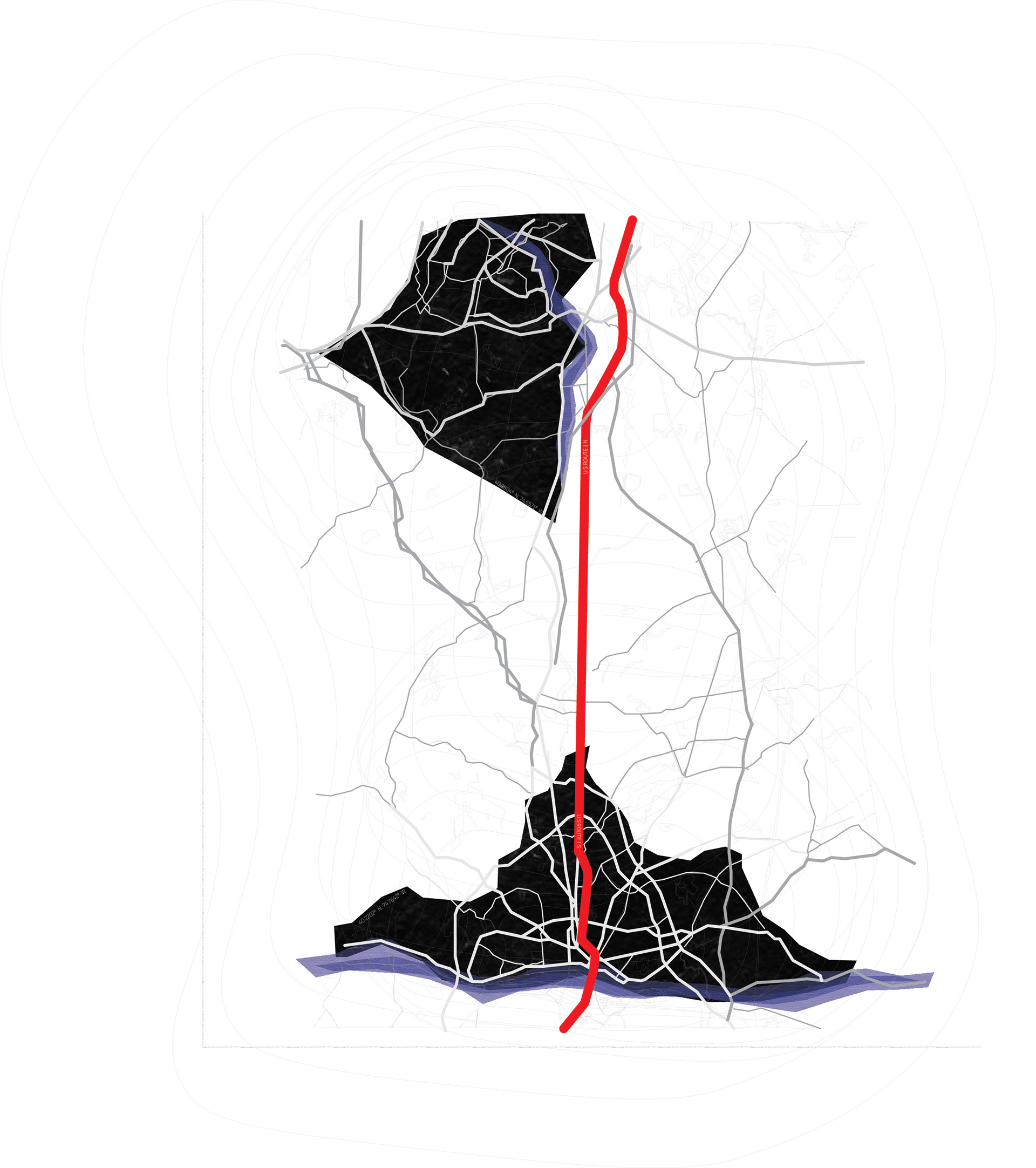
Trenton-Princeton Corridor (Route 1 S-N)
Decay and Environmental Neglect as Racialized Geography
While cultural fragmentation defines the social landscape, environmental degradation marks the physical landscape. Trenton is a city burdened by the toxic legacy of its history as a major East Coast industrial center, notably for manufacturing products like pottery, iron, steel, and rubber. Anyone who has passed by the Delaware River has seen the bright illuminated slogan of the city, "Trenton Makes, The World Takes." After some time, however, Trenton gave way to brownfields, superfund sites, and heavily polluted waterways. These are not accidental; they are spatial consequences of racialized zoning and long-term negligence, a primary example being the Roebling Steel site. Once an industrial icon has been reduced to a polluted landscape, it is undergoing a rough and bumpy cleanup operation.
These toxic zones disproportionately impact low-income and racialized communities. Exposure to lead, industrial runoff, and poor air quality leads to long-term health disparities, generational trauma, and decreased quality of life. These are not passive conditions. They result from active policy decisions that deemed some land, and unfortunately some lives, as expendable.
Princeton offers a carefully managed environment. The expansive lawns, strict zoning regulations, and intentional environmental practices often conceal issues of exclusion. While there is plenty of green space, access to and enjoyment of these areas are limited and overly sanitized. Natural environments are "preserved" not for the benefit of the community, but rather for aesthetic appeal and institutional prestige.
This curated approach creates a sense of separateness, where only a select few can fully engage with the landscape. The design often prioritizes aesthetics over accessibility, making it less inviting for those outside the honored elite circles. As a result, the collegiate town seems to prioritize its image rather than fostering genuine community interaction and authentic connection with nature. This contrast creates a spatial contradiction: abundance versus abandonment, manicured versus contaminated.
The divide is maintained by infrastructures of separation. Highways, power lines, and zoning boundaries not only segregate but also degrade. These infrastructures produce what urban theorist Mike Davis calls "fortress urbanism," where security and surveillance shape space more than care or community. They also reflect what architect and theorist Elisa Iturbe calls the spatial violence of carbon modernity, fossil-fueled progress that generates inequality and ecological destruction. As Iturbe writes, "Spatial inequality is not merely the result of outdated design, it is actively produced and reproduced." Artist and writer Robert Smithson's work reminds us that ruins are not just what's left behind, but they are active processes, revealing systems of control and collapse simultaneously. He describes modern landscapes as "ruins in reverse... buildings that, rather than fall into ruin, are built that way from the start."
The presence of decay does not significantly abandon alone; it is an invitation for rethinking how care and regeneration might be spatially enacted. In Trenton's toxic landscapes, fungi already play a quiet role in bringing about this transformation. Mycelial growth often begins in the very conditions deemed uninhabitable by human standards: damp, dark, nutrient-depleted spaces. These sites, under rail bridges, near old foundations, between cracked concrete, are precisely where fungicidal thrives. What if these overlooked spaces were formally recognized as beginnings, not endings?
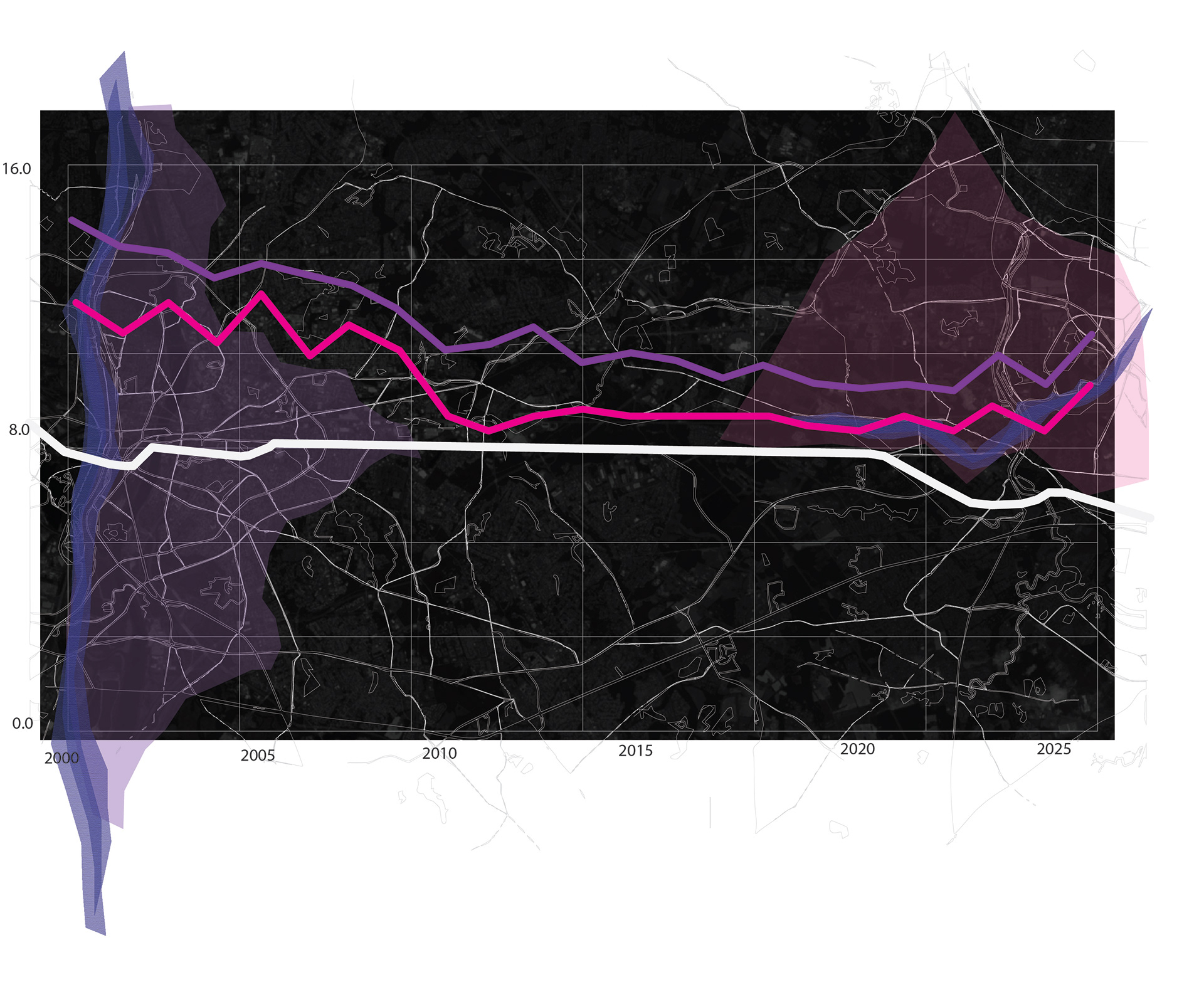
Incorporating fungal borders into planning and restoration efforts offers a radically different approach to post-industrial land use. Rather than razing and replacing polluted zones, multispecies strategies would allow mycelium to remediate, slowly and organically, creating conditions for future ecological and cultural inhabitation. For example, a fungal border project could line up in use or abandoned rail tracks alike. Or highway edges with decomposable substrates, seeded with fungi specifically selected to absorb heavy metals and chemical pollutants, Aspergillus niger, Trichoderma harzianum, Pleurotus ostreatus, and Phanerochaete chrysosporium are particularly well-suited for their capacity to extract pollutants from soil and water. These networks would act as soft, living boundaries, marking space while healing it.
These fungal zones could be layered into urban and suburban planning as buffers between neighborhoods, living installations in parks, or even as cultural markers that visualize the ongoing process of repair. Such projects challenge the sterilized green infrastructure of Princeton, showing that thriving ecosystems do not always look pristine. In doing so, they offer a new vision for justice-centered land management: one where decay is not feared, but embraced as the foundation for new relations.
Mycelium as Blueprint for Multispecies Regeneration
Amid these fractured landscapes, fungi offer a quiet but radical alternative. Mycelium networks break down toxins, rebuild soil, and foster interdependence. They are resilient, slow, and non-hierarchical; everything that carbon modernity IS NOT. In Trenton’s brownfields and along Princeton’s over-manicured lawns, fungi symbolize ecological restoration and a metaphorical rethinking of current “borders.”
Fungi do not recognize human zoning lines (obviously); they sprawl, connect, and decompose barriers. Their networks are built on cooperation rather than extraction. What does it mean to imagine a landscape molded (haha) by these values?
Imagine fungal remediation sites along the Trenton-Princeton corridor, “mycoremediation fields” growing from former dumps, transforming the toxic land into community gardens or greenhouses. What if we designed public spaces WITH decay instead of against it? What if community centers were grown rather than built, blooming from fungal networks instead of concrete foundations?
These ideas are not purely speculative. Across the world, architects and biologists are experimenting with mycelium-based construction, living walls, and fungal insulation. In post-industrial regions of Europe and the US, fungi are used to neutralize soil contaminants and rebuild biodiversity. Trenton could follow suit, transforming its post-industrial ruins into regenerative hubs, while Princeton’s sterile green space could evolve into living laboratories, cohabitation spaces, and educational sites.
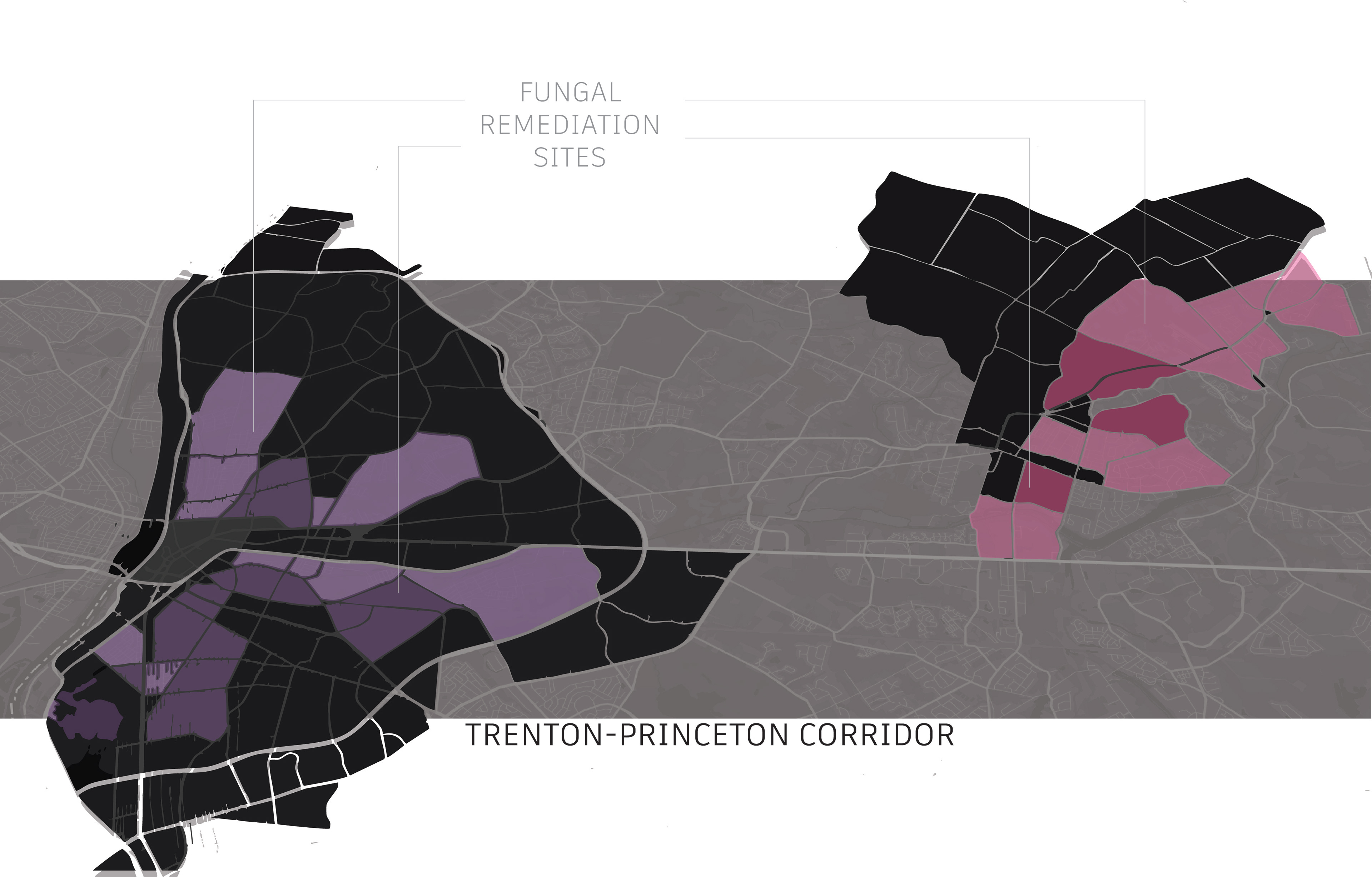
Site in need of "remediation" along the Trenton-Princeton Corridor
Tsing’s discussion of multispecies survival in capitalist ruins describes fungi as collaborators in regeneration, not just decomposers. “Possibilities emerge from within the ruins, not beyond them,” she writes, suggesting that repair can only begin by working on what’s been broken. Building new things does not always work. Not anymore. Philosopher Timothy Morton’s concept of hyper-objects expands this thinking to the planetary scale, framing ecological entanglements as a condition of life. “We are inside what we’re trying to study,” Morton notes, emphasizing that human and nonhuman systems are inextricably entangled in ways we can’t always perceive. James Corner’s speculative diagrams encourage us to design not for certainty, but for open-ended, temporal transformation; designing with decay, not against it.
Recent advancements in fungal-based architecture and material science have shown how mycelium is not only a metaphor but a viable material for post-carbon, regenerative design. Architects and researchers have been developing biodegradable mycelium bricks, insulation panels, acoustic tiles, and lightweight structural elements. These materials are carbon-sequestering, compostable, and grown from agricultural waste, challenging the extractive qualities of conventional construction practices.
One key example is the work of The Living, a New York-based architecture firm that created the “Hy-Fi” pavilion using mycelium bricks grown in molds. The structure was temporary and fully compostable, leaving behind no waste. This offers a design model that participates in ecological cycles. The Growing Pavilion, a project by Biobased Creations and Dutch Design Foundation in the Netherlands, explores mycelium’s potential as a flexible, climate-responsible material. Such prototypes open doors for implementing fungal architecture not just in experimental contexts but in everyday environments.
For industrially scarred cities like Trenton, these applications are especially powerful. Abandoned factories and lots could be transformed using on-site remediation systems and myco-architecture to build community structures that both serve and heal. Imagine a community greenhouse, co-designed with residents, constructed from mycelium grown on waste straw, actively detoxifying the air and soil around it. In Princeton, mycelium-based design could intervene in overly sterile green spaces, creating educational and ecological installations in schools, parks, and libraries. These could serve as living labs for sustainability, public engagement, and alternative histories. In this context, mycelium acts as both a fundamental building block and a storytelling medium. It reminds us that true thriving often comes not from domination, but from entanglement and connection. Expanding on this concept, these mycelium installations could incorporate interactive elements that engage community members of all ages. Workshops could be organized to teach about the life cycle of mycelium and its essential role in ecosystems, promoting an understanding of biodiversity and the interconnectedness of life. Artists could collaborate with scientists to create installations that visually represent the mycelial networks beneath our feet, fostering a sense of wonder and curiosity.
These spaces could also feature edible gardens nurtured by mycelium, demonstrating sustainable practices in urban gardening. The organic growth process of these installations could serve as a metaphor for the community’s growth, illustrating how diverse relationships contribute to a healthy ecosystem. In addition to serving as educational resources, mycelium installations would create a space for dialogue, where voices from different backgrounds and experiences come together to share their narratives. This can strengthen community bonds and encourage a culture of care and stewardship for the environment. Ultimately, the integration of mycelium-based design would not only enhance the beauty of these green spaces but also cultivate awareness and respect for the natural world, promoting a more harmonious coexistence with nature.
Conclusion
The Trenton–Princeton corridor is not merely a geographic transition from urban to suburban or poor to rich; it is a landscape shaped by deep structural divisions. Yet within its fractured terrain lie the conditions for regeneration. The toxic brownfields and manicured campuses reveal more than disparity; they expose layered differences in race, class, and cultural visibility.
Trenton, home to long-standing Black and Latinx communities, has endured decades of environmental neglect and economic disinvestment. Princeton and Plainsboro, shaped more recently by growing South and East Asian populations, often appear prosperous but remain spatially and culturally fragmented, with immigrant presence obscured by the suburban form. These differing realities reveal distinct yet connected forms of marginalization, reminding us that visibility and care are unevenly distributed. Still, the corridor offers opportunities to build solidarity across these fragmented communities. As educators, organizers, and artists begin to collaborate across municipal lines, sharing cultural practices, reimagining land use, and forging public space from decay, new forms of regional identity begin to emerge.
If we view this corridor through the lens of fungal ecologies, networks that thrive in ruin, nourish from waste, and build resilient systems of care, we might begin to ask different questions about design and community.
If we view this corridor through the lens of fungal ecologies, networks that thrive in ruin, nourish from waste, and build resilient systems of care, we might begin to ask different questions about design and community.
Fungi offer not just metaphors but blueprints for action: slow, interconnected, and deeply rooted. They ask us to embrace slowness, to trust in transformation, and to rebuild not by erasure but by entanglement. What if borders did not divide, but decomposed…what new life might grow in the spaces between?